Taking Formula 1 to Las Vegas is a headline-writer’s dream: Sin City is the place to go all-in, to roll the dice, to push the limits and risk it all… and it feels like the Grand Prix has caught a whiff of that too, with a circuit that offers low grip, unforgiving walls and plenty of overtaking opportunity for those prepared to gamble.
So how will the teams, drivers and strategists approach the weekend? It’s time to take a look in The Risk Perspective, in partnership with Marsh, Formula 1's Official Risk Partner and Official Insurance Brokering Partner.
The Set-Up
The F1 season has always enjoyed a mix of normal and oddball circuits, and while the modern eclectic calendar makes it hard to know what constitutes ‘normal’, Las Vegas is certainly out on the periphery of ‘oddball’, not because it’s a bumpy street track with very long straights, but because it’s very, very cold!
Racing in the high desert at night towards the end of November inevitably sees the mercury plunge and has teams reaching for the beanies, gilets and fingerless gloves that haven’t had an airing since winter testing in January. It provides the car with some power unit cooling for free, allowing it to run with tight bodywork and fewer shoulder louvres than usual.
Given the extreme temperatures at which the brakes of an F1 car operate, 10-20°C of ambient temperature doesn’t make much difference, but brake cooling is still a huge factor in Las Vegas, with the requirement being the opposite to most circuits, as the teams try to retain heat rather than reject it, potentially with seals on the brake drums.
The heat from the brakes is conducted into the wheels and used to warm the tyre carcasses, but it’s also valuable because of the length of the Strip Straight.
If the brake cooling is too effective, the cars arrive in the huge braking zone at T14 with cold brakes and no stopping power. There is, however, a balance to be achieved. Too much cooling and the cars struggle at the ends of the straights; too little and they overheat around the rest of the lap.
The big issue in these cold conditions is the potential for ‘graining’. This phenomenon is rubber tearing off the tyre surface in strips, and then immediately re-adhering to the surface of the tyre. It causes a significant reduction in grip and makes the cars very difficult to drive.
Sometimes this will simply be a phase the tyre goes through, with the grip returning once the surface has worn smooth again – but sometimes it doesn’t go away.
Avoiding – or limiting – graining is more art than science, usually aided by the driver introducing the tyre gently, rather than pushing too hard, too early, which leads to a tricky decision at the start of each stint, and a gamble between securing a position and looking after the long-term.
There are set-up tweaks that can help: the front-right has been the most susceptible tyre in Vegas, and so teams look to protect it with tweaks to lateral balance, and even by employing an asymmetrical set-up.
In terms of downforce, the length of the straights prompts teams to take downforce off the cars. The original belief with active aero was that F1 would stop producing the plethora of rear wings that characterised previous eras, but the empirical evidence is that designers still have some shots in the locker when it comes to rear wing type, and this weekend they’ll have the skinnier versions out.
That isn’t without risk, because taking downforce off the cars – on a track that’s inevitably going to have low grip already – is going to make them difficult to drive. But better this than being slow on the straights and a sitting duck when it comes to overtaking.
The Strategy: Guillaume Ducreux, Trackside Strategy Engineer, Racing Bulls
“Every track has its own characteristics, and in Las Vegas, the thing we’re very keen to understand is tyre graining. 2024 was heavily impacted by graining, which was the primary reason the race was two-stop. The graining was much-reduced in 2025 and without that limitation, the race was a one-stop.
“Obviously, for strategists, whether or not we have heavy graining in 2026 will be the main question to answer during practice. The long runs in FP2 should tell us what we can expect on Saturday night.
“Overall this year, we have not seen many instances, but we did see severe graining in Shanghai, all the way back in March. The significance of this comes from the fact the Chinese Grand Prix was impacted by low temperatures, and this weekend, racing at night in the desert, we’ll have temperatures that are likely even lower – and that could create the right conditions to see graining again.
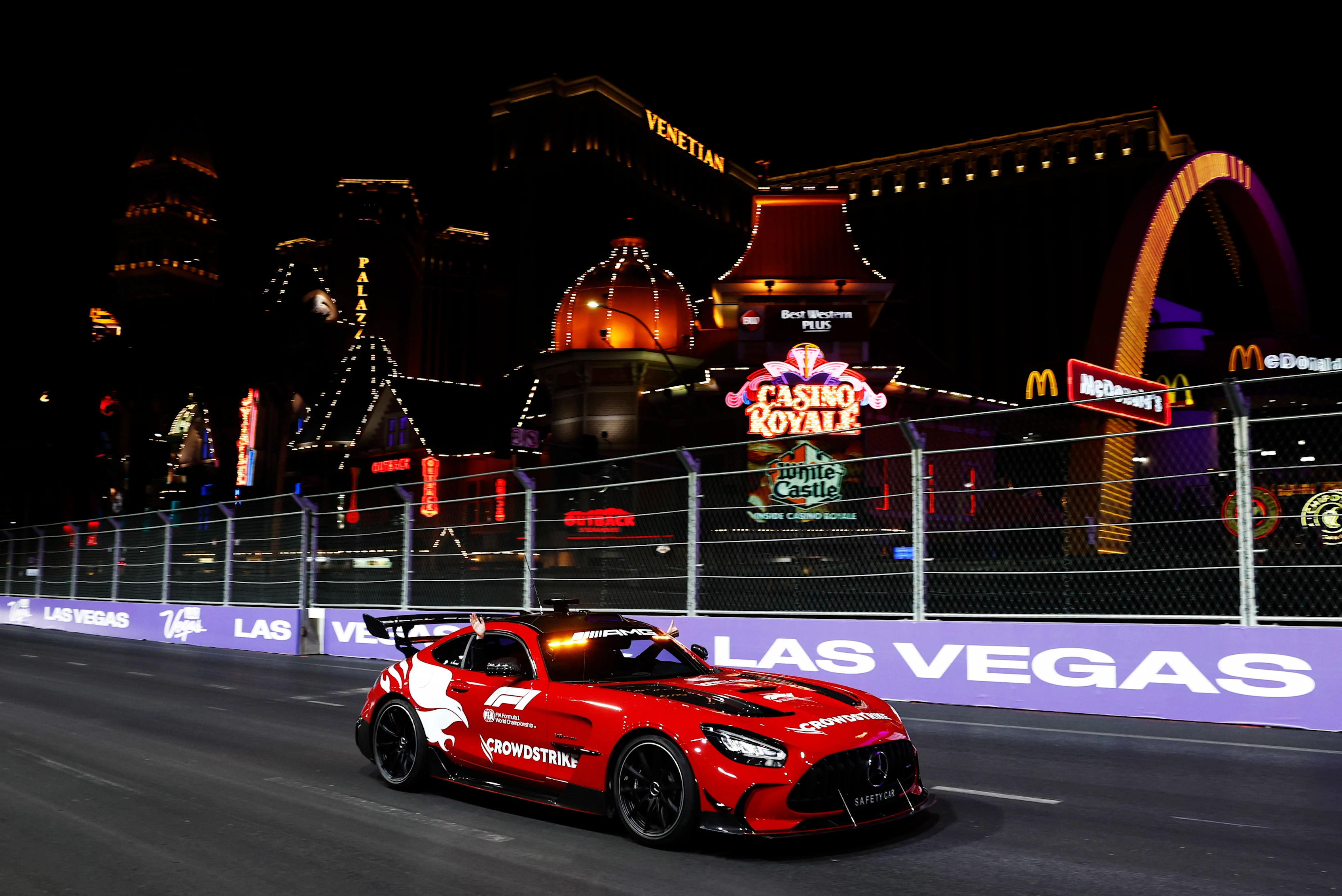
“The last three years tell us this is a circuit where it is possible to overtake – but equally it’s also a race where track position is important. Being a street circuit, the chances of a Safety Car are high, and thus you want to have track position, want to be ahead, and thus limit your exposure to Safety Cars or red flags. That’s also a strong incentive to not box too early.
“Whether race pace or track position is more important really will depend on what sort of race we get. If it’s a two-stop, then race pace becomes more and more important, because you will have more opportunities during the race, whether that’s through undercuts or offsetting your stops [to build a tyre delta].
“Should we end-up with a one-stop race, obviously this moves the bias towards Qualifying pace and holding track position, because there will be fewer strategic opportunities. We could be in either scenario – it really will depend on how the tyres are behaving.”
The Drivers’ Perspective: Lando Norris
“It is certainly one of the hardest races of the year. There isn’t a lot of room for error – quite tricky and quite quick in terms of being a street circuit. There are white lines [on the asphalt], and all of that paint can be pretty horrible at times, when you’re in the car feeling these kinds of things. All in all, it will be a pretty insane challenge!
“Obviously, it’s cold, which is one of the biggest things, which leads to graining on the tyres, which is not always an easy thing to understand. We’ve had rain here, and it’s an incredibly difficult track in the rain – pretty nasty! And it won’t dry very quickly because of the temperature.”
The key section: Turn 12
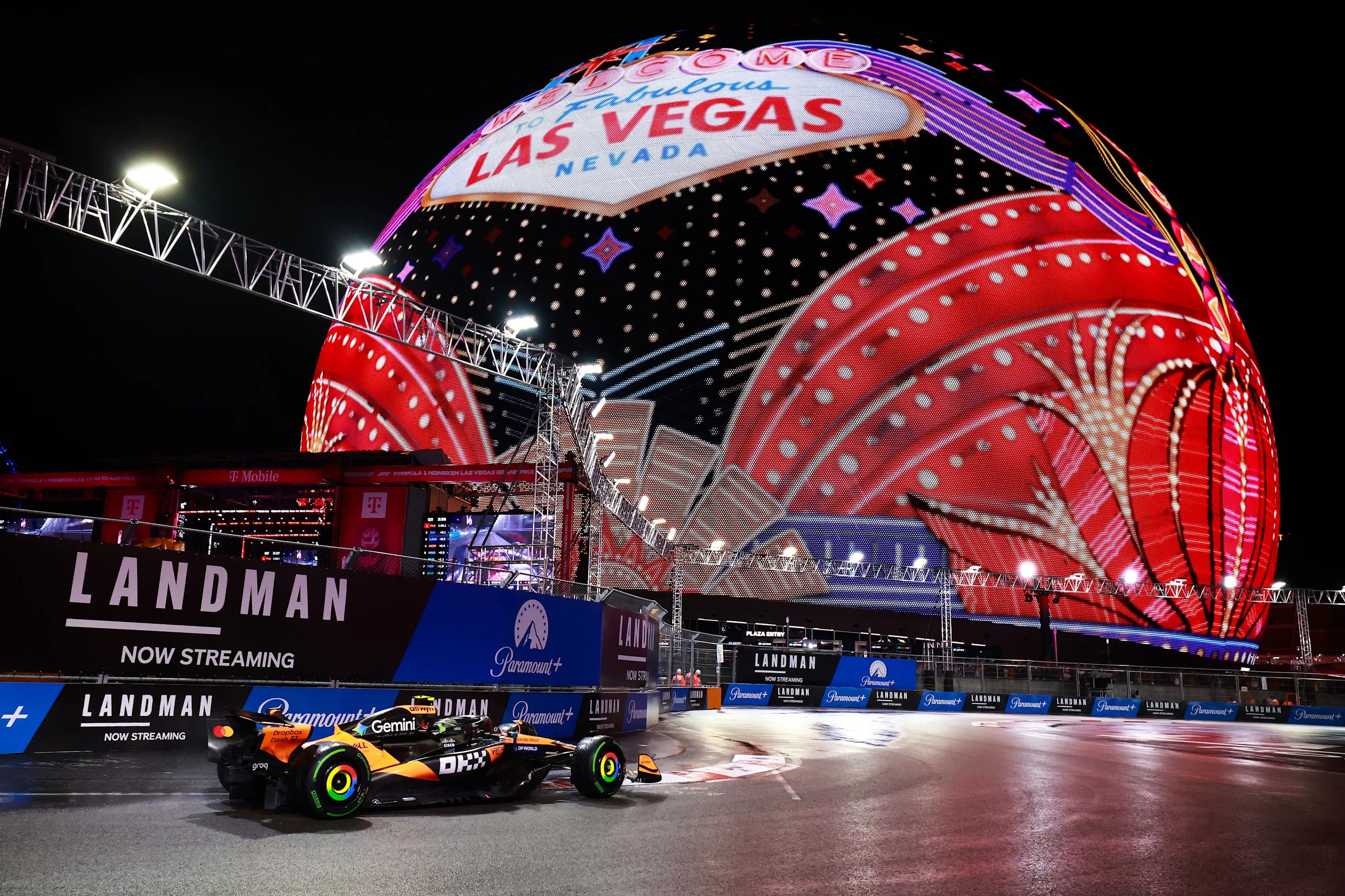
For the sake of brevity it’s Turn 12, but the wonderful thing about racing in Las Vegas is that you’re never short of descriptions, so really it’s the junction of Sands Avenue and The Strip. There’s a high-speed section after The Sphere, following the twisting Sands Avenue past the Venetian, then a hard left onto The Strip by Treasure Island.
It’s a tight corner, approached at high speed on a bumpy section of track, and has seen plenty of cars locking-up and taking to the run-off – and in the case of Lando Norris in 2023, getting out of shape over the bumps and having a sizeable impact on the approach.
It's important, however, for more than just the potential to embarrass. Getting a good exit is crucial for performance all the way down the 1.9km straight that follows – and more so this year where it will impact energy deployment. Teams will therefore cant their set-up to ensuring the cars have good traction.
The Greatest Race: 2023 – A frenetic debut
The inaugural Las Vegas Grand Prix didn’t get off to the best of starts. First practice began at 2030 and ended approximately seven minutes later. A poorly-secured drain cover was pulled-up, damaging the cars of Esteban Ocon and Carlos Sainz.
The session was red-flagged and, as is the protocol in these situations, Race Control instituted checks on the welds of all the other drain covers which, on a street circuit measuring 6.2km, took quite a while. FP2 was delayed, leading to the bizarre spectacle of F1 cars still being on track shortly after 4am. Fortunately the race itself on Saturday evening was a fire-breathing monster.
The Ferraris had locked-out the front row but Sainz, as a result of his drain-cover related damage, also had a PU penalty to take, having ripped open the bottom of his car and damaged the Energy Store. He was relegated to P12, with Max Verstappen promoted to the front row.
Verstappen nipped through at the start to take the lead from Charles Leclerc, though he picked up a penalty for running off track. There was a VSC almost immediately to clear up damage from a collision down the field and a full Safety Car soon followed when Norris went off at the restart – providing a stark and early illustration of how the ultra-high speed circuit had real fangs.
Up top, there was a battle royale, with Leclerc harrying Verstappen and regaining the lead, before Verstappen dove into the pits for an early stop and to serve his penalty. Leclerc came in five laps later and the lead passed to Sergio Perez. The Mexican had started P11 and dropped to P18 at the start, before carving his way through the field.
Checo needed a bit of luck to properly get himself back into contention and it came via a collision between Verstappen and George Russell at T12, and a subsequent Safety Car required to clean up the debris. Russell picked up a penalty for that one.
Most of the field, including both Red Bulls, took advantage of the caution for a cheap stop, but crucially, Leclerc did not, and thus reassumed the lead of the race, which restarted on Lap 29 for 21 laps of high drama. Perez put a great move on Leclerc to recapture the lead on Lap 32, pulling out of the slipstream at the end of the Strip Straight. Leclerc took it back on 35 in the same spot.
Verstappen slipped past Perez on the next lap, then took the lead on Lap 37, and then Perez passed Leclerc when the Ferrari had a lock-up and when deep into T12 on Lap 43. The Red Bull 1-2 was not to last, however, with Leclerc staging a last lap, last-gasp recover to take P2 in the final braking point of the race and came home 0.171s ahead of Perez.
Breathtaking stuff, and the Las Vegas Grand Prix was off to a flier. The calamity of Thursday was largely forgotten, and F1’s return to Las Vegas was up and running with overwhelmingly positive vibes.
The Strategic Masterstroke: 2025 – Kimi rolls the dice
Last year, everyone did a one-stop… but not all one-stops are the same. Kimi Antonelli’s race stands out. He used an offset strategy to rise from P17 on the grid to P4 at the flag, which retrospectively became P3, and only passed two cars on track to do it.
It’d be notable for the sheer economy of effort alone… but it’s also worthy of note for reading conditions perfectly.
Antonelli started P17, ejected in the Q1 lottery as the track improved and times tumbled. With everyone improving on their final laps, he picked the wrong lap on which to have a lock-up, and was out.
The Mercedes W16, however, had decent pace – and Kimi just needed some clean air in which to use it. He was the only driver to start the race on the desperately-unfancied soft compound, and indeed, the only driver to use it in the race.
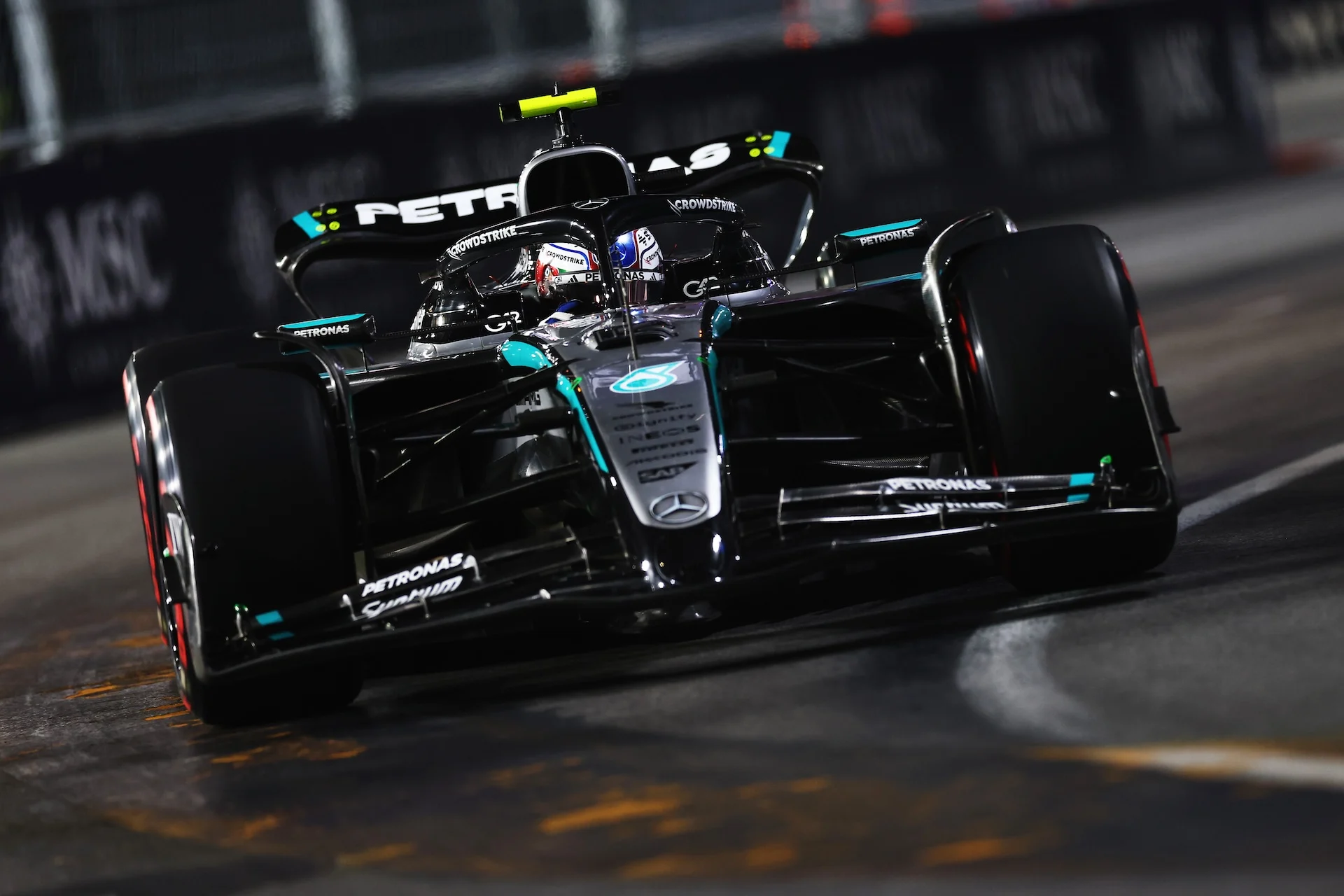
The intention was clearly a short, sharp, opening burst, then an early stop, hoping to undercut cars ahead. An early VSC, however, made that opening stint very short and very sharp, with the Mercedes driver pitting on Lap 2, and doing the rest of the race on the hard compound.
Antonelli rose to P14 on the first lap, dropping to P15 with his stop. Stopping under a VSC had a pit-loss time of 13.5s versus 20s for a green flag stop, and thus he gained considerable virtual ground, passing cars as they pitted ahead and came out behind.
While the hard was robust, completing 48 laps required very careful management, and Antonelli and his engineering group had to hold their nerve to push through a period of graining in the middle of the race, waiting for it to clean-up, rather than pitting for a second set of hards.
“Kimi had a great race considering his start position,” said Andrew Shovlin, Mercedes’ Trackside Engineering Director.
“We knew starting on the soft and stopping early was a risk but if the hard tyre held on to the finish, it was our best chance to get him into good points. We took the opportunity presented by the early Virtual Safety Car and from there he drove brilliantly to keep his tyres in good shape, whilst making some critical overtakes.”
The Risk Perspective is brought to you in association with Marsh, Formula 1’s Official Risk Partner and Official Insurance Brokering Partner.

Next Up
Related Articles
 Haas confirm Camara to race for the team in Las Vegas
 Formula 1 and WHOOP announce landmark partnership
 Piastri set for grid penalty at Las Vegas Grand Prix
 Behind the lens with Mark Sutton for Antonelli's F1 title triumph
 BettingLas Vegas Grand Prix betting guide and latest odds
 UnlockedQUIZ: Can you identify these F1 tracks from just one picture?